The AI product label that's actually three labels!
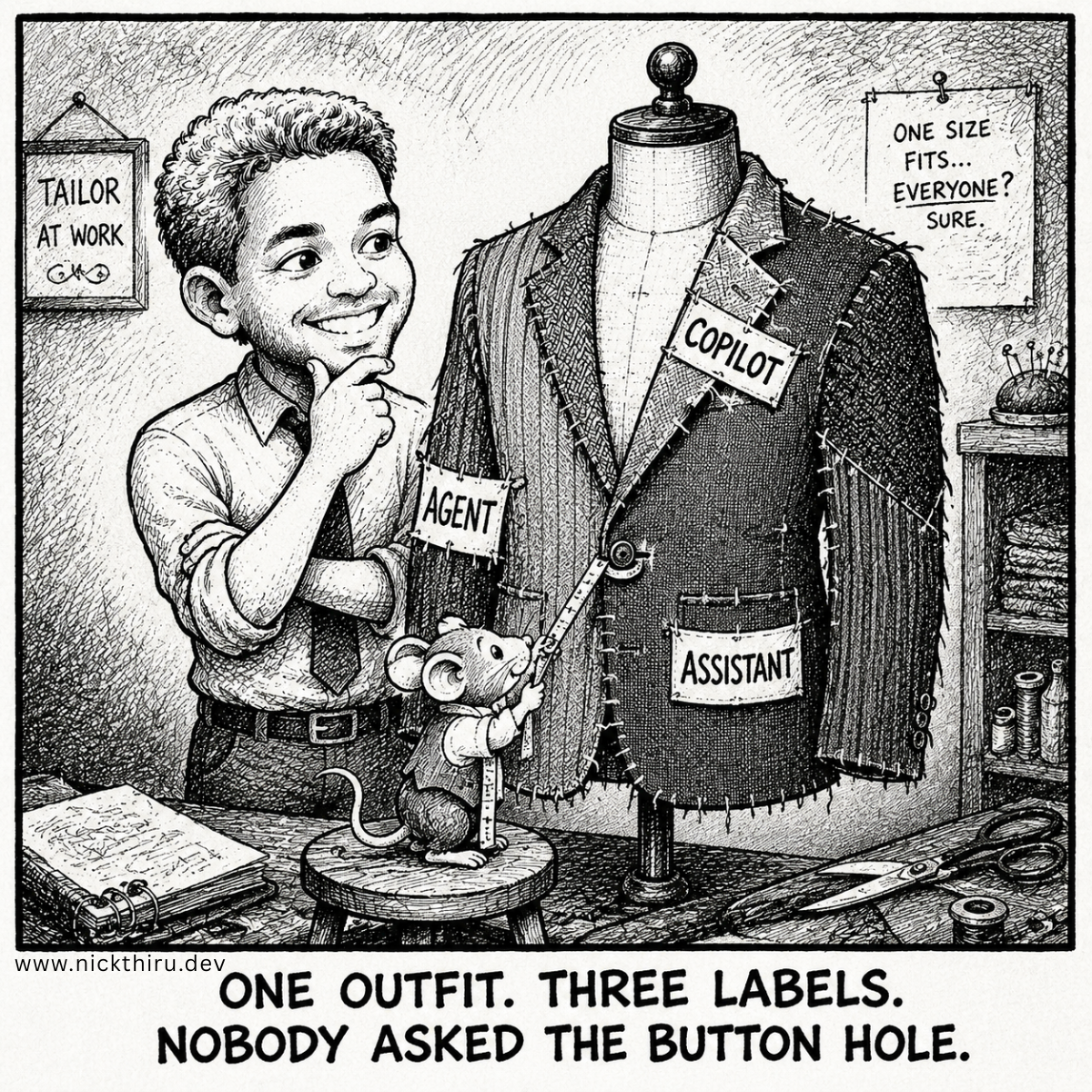
Why “Agent vs. Copilot vs. Assistant” Is the Wrong Question (And What to Ask Instead)
If you’ve spent any time around AI product teams in the last two years, you’ve probably sat through a version of this argument: is the thing we’re building an agent, or is it a copilot? Someone pulls up a whiteboard. Someone cites a taxonomy. Someone points out that the system “sort of does both.” The meeting ends without a decision, and the roadmap sits there, waiting for a label that never quite fits.
The argument isn’t unproductive because the people in the room are confused. It’s unproductive because the question itself is malformed. It also usually forgets there’s a third label in the room: Assistant. “Agent, copilot, or assistant” implies a single system has to be one thing all the way through — a fixed identity, chosen once, applied uniformly. Almost nothing built in the real world works that way. The moment you try to force a genuinely mixed system into a single category, you get exactly the kind of stalled, circular debate that whiteboard meeting produces, because you’re asking the system to resolve an ambiguity that belongs to the framing, not to the product.
There’s a better question, and it’s less abstract than it sounds: what is this specific action allowed to do without a human, and what is it never allowed to do without a human? That question can be answered capability by capability. It doesn’t require picking a label first. And once you have those answers, the label (if you still want one), falls out as a consequence, not a prerequisite.
A concrete case: OpsPilot
Take a real example. OpsPilot is a small-business operations tool being built to handle the unglamorous background work of running a company: reconciling invoices, flagging at-risk accounts, drafting support responses, triaging incidents. During its product classification phase, We ran into exactly the stuck debate described above. Some capabilities looked like a copilot: they interpret data and generate suggestions for a human to act on. Others looked like an agent: they invoke third-party tools, hold state across time, and adapt based on what happened last time. Forcing the whole product into one bucket would have meant either overstating what it does (calling read-only dashboards “agentic”) or understating it (calling multi-step, tool-invoking workflows “just a copilot”).
Our own documentation is explicit about why this distinction actually matters and isn’t just semantic housekeeping. It notes that domain-specific components — a Support Agent, a Billing Agent, an Incident Triage Agent — “break goals into tasks, invoke third-party tools, manage state, and adapt from feedback,” which is the textbook definition of agent behavior, and which a copilot, by contrast, does not do; a copilot is “UI-embedded, context-aware suggestion without persistent multi-step task execution”. So we locked the product’s overall category as Agent, explicitly rejecting Copilot and Assistant as insufficient descriptions of what the system actually does end-to-end.
But — and this is the part that the simple label framing can’t hold — locking the category didn’t mean every capability inside the product behaves the same way. Our own analysis names this directly: several of OpsPilot’s interpretation, generation, and decision-support moments are “legitimately implemented as Copilot-style sub-components embedded inside the Agent architecture”. In plain terms: the product is an Agent, and it contains Copilot-shaped parts, at the same time, without contradiction. That’s not an edge case. That’s what most real systems with any complexity look like once you examine them capability by capability instead of trying to summarize them in a single word.
Where the real work happens: the boundary table, not the label
Here’s where the reframe earns its keep. Once you stop asking “which of the three labels fits” and start asking “what can this specific action do without a human,” you get something a debate about labels never produces: a table you can actually build a product against.
OpsPilot’s autonomy boundary table lays this out capability by capability. A churn-risk alert is purely informational — “no autonomous action taken”. A payment retry requires an approval gate because it’s a financial, customer-facing action that needs an explicit human trigger. A routine action capability starts out fully approval-gated, but the table also names the exact mechanism by which that could later loosen — a configurable exception-routing threshold — without pretending the system has already earned that trust. None of these lines required agreeing on a single word for the whole product first. Each one is a decision about one action, made on its own terms.
This is the practical payoff of asking the right question instead of the wrong one. “Which label wins” produces a stalemate, because it’s asking for one answer to a question that has 22 different correct answers, one per capability, in OpsPilot’s case. “What can this action do without a human” produces a table, and a table is something an engineering team, a designer, and a founder can actually build against, argue about individually, and revise one row at a time as trust is earned.
Why the UX consequences prove the point
If the label debate were purely academic, it wouldn’t matter much which side won. It matters here because the architecture and the user experience genuinely change depending on the answer — and they change per capability, not per product.
OpsPilot’s architectural documentation makes this concrete: the product needs “a review-and-approve UX pattern layered on top of otherwise autonomous task execution…not a chat-first UX, and not (yet) a fully invisible background-agent UX”. That single sentence contains three different UX philosophies, rejected or adopted for different reasons, inside one product. A pure copilot UX would frame the whole system as suggestion-only, embedded in the founder’s existing tools, but the documentation is explicit that this “understates” what the payment-retry and routine-action capabilities actually do. A pure assistant UX, where you ask the system to do one bounded task on demand, would undersell the product’s continuous, unprompted, cross-domain monitoring. None of the three labels alone describes the actual interface that had to be built. What is being built instead — batched approval queues, draft-then-send patterns for outbound messages, a dedicated autonomy control panel that makes the boundaries “legible and adjustable” rather than fixed in code — is a direct answer to the capability-by-capability question, not to the category question.
The failure-mode analysis makes the stakes even sharper. It was noted that a copilot’s failure mode is typically just “annoying, intrusive, or irrelevant assistance,” while an agent’s failure “can fail loudly and expensively,” and that the entire approval-gate architecture exists specifically to keep an Agent-class system’s failure modes closer to that cheaper Copilot profile until trust is earned. That’s not a taxonomy exercise. That’s risk management, done at the level where risk actually lives: individual actions, not product-wide labels.
A second case: PolicyForge, and the label that almost slipped through wrong
If OpsPilot shows what happens when a product turns out to be a mix of Agent and Copilot, a second product — PolicyForge — shows the third label earning its place, and shows how easy it is to get even a single capability inside that label wrong without noticing.
PolicyForge is built for someone like Michael, VP of Operations at a 30-person manufacturing subcontractor that needs to demonstrate CMMC compliance to keep bidding on Department of Defense contracts. He’s not a compliance expert, there’s no in-house compliance team, and a consultant costs $5,000 to $15,000 and takes longer than the bid window allows. PolicyForge runs him through a guided interview and drafts the first pass of the policy documentation itself.
Before locking the product’s category, we had already reasoned our way to Assistant: not a chat companion you argue with, and not something that plans multi-step work and acts on its own while you’re not watching; something that does one bounded thing well and hands the result back for a human to check before it goes anywhere near an assessor or a prime contractor. That’s the textbook shape of Assistant: bounded, proposal-only, no default-on autonomy.
Then we did something worth copying: instead of treating that label as settled, we went back and tested it against every single capability on the list, one at a time, refusing to wave through the ones that “obviously” fit. Most passed cleanly. But one didn’t, and it’s a useful case precisely because of how it slipped through. It looked like formatting — the AI simply organizing information a person had already reviewed, a step that felt downstream of the real judgment calls. But tracing through what happened if that organizing step got something wrong revealed the actual stakes: it could quietly reorder priority or emphasis in a way that changed what a reviewer thought they were approving, without them realizing the framing itself had shifted. That’s not formatting. That’s a decision wearing formatting’s clothes, and it had been filed, incorrectly, as something the AI could just do, full autonomy, no checkpoint.
The fix wasn’t to throw out the Assistant label. The category held. What changed was one capability’s checkpoint: it moved from “the AI just does this” to “the AI proposes, a person signs off before it goes further.” And the ripple effect is the real lesson here: that single correction reshaped how the interface presents unfinished, AI-drafted content versus something a person has actually confirmed, everywhere in the product, not just at the final step before a document ships.
Notice what didn’t happen anywhere in that process. Nobody asked “is PolicyForge secretly an agent?” or reopened the whole taxonomy debate. The category — Assistant — was correct at the product level from the start. What needed scrutiny wasn’t the label; it was whether every individual capability actually lived up to what that label promises: that nothing moves forward until a human actively approves it. One capability, quietly, didn’t…until I checked it.
What the three labels actually are for
Put OpsPilot and PolicyForge side by side and the three labels stop looking like rival categories fighting for one product and start looking like what they actually are: descriptions of how much a capability is allowed to do before a human has to look at it.
- Assistant: proposes one bounded thing, and nothing happens with the output until a person actively approves it. No default-on autonomy, no silent forwarding.
- Copilot: surfaces context-aware suggestions embedded in a UI, without executing multi-step tasks on its own.
- Agent: breaks a goal into tasks, invokes tools, holds state across time, and adapts — with approval gates layered on top wherever the cost of being wrong is too high to hand over quietly.
A product can be built almost entirely from one of these, like PolicyForge. A product can be officially one of them while containing pieces of another, like OpsPilot being an Agent with Copilot-shaped parts inside it. Either way, the label was never the thing doing the work. The work was always the capability-by-capability question underneath it.
What to ask instead
So if picking a single label first is the wrong move, here’s the question that actually moves a stuck conversation forward, in five parts:
- What does this specific action actually do — does it just surface information, or does it take a step that changes something in the world (sends a message, retries a payment, closes a ticket, reformats what a reviewer is about to sign off on)?
- What happens if it’s wrong — is a mistake here merely annoying, or is it the kind of failure that’s “loud and expensive”?
- Does it need a human in the loop today — not forever, but right now, given how much trust the system has actually earned?
- What would have to be true for that human checkpoint to loosen — a confidence threshold, a track record, a specific volume of clean outcomes?
- Is that boundary visible and adjustable, or is it quietly hardcoded somewhere nobody will remember to revisit?
Answer those five questions for one capability at a time, and you’ll have something a label debate never produces: a decision you can actually build, ship, and revise. The label, if you still want one afterward, will follow from the answers. It was never supposed to come first.
Your Turn
Next time you catch your team arguing about whether something is an “agent”, a “copilot”, or an “assistant”, try swapping the question to “what is this allowed to do without me?” Does that change the conversation for you, or make it harder?
Have thoughts on this? I'd love to hear them. The conversation is happening on: