1 From Dashboard to Decision-Maker
OpsPilot — From Dashboard to Decision-Maker
· 7 min read
Product OpsPilot Strategy
You're reading Part 1 of 3 in the OpsPilot series.
Use the Series Navigation button at the top-right to browse all posts in the series.
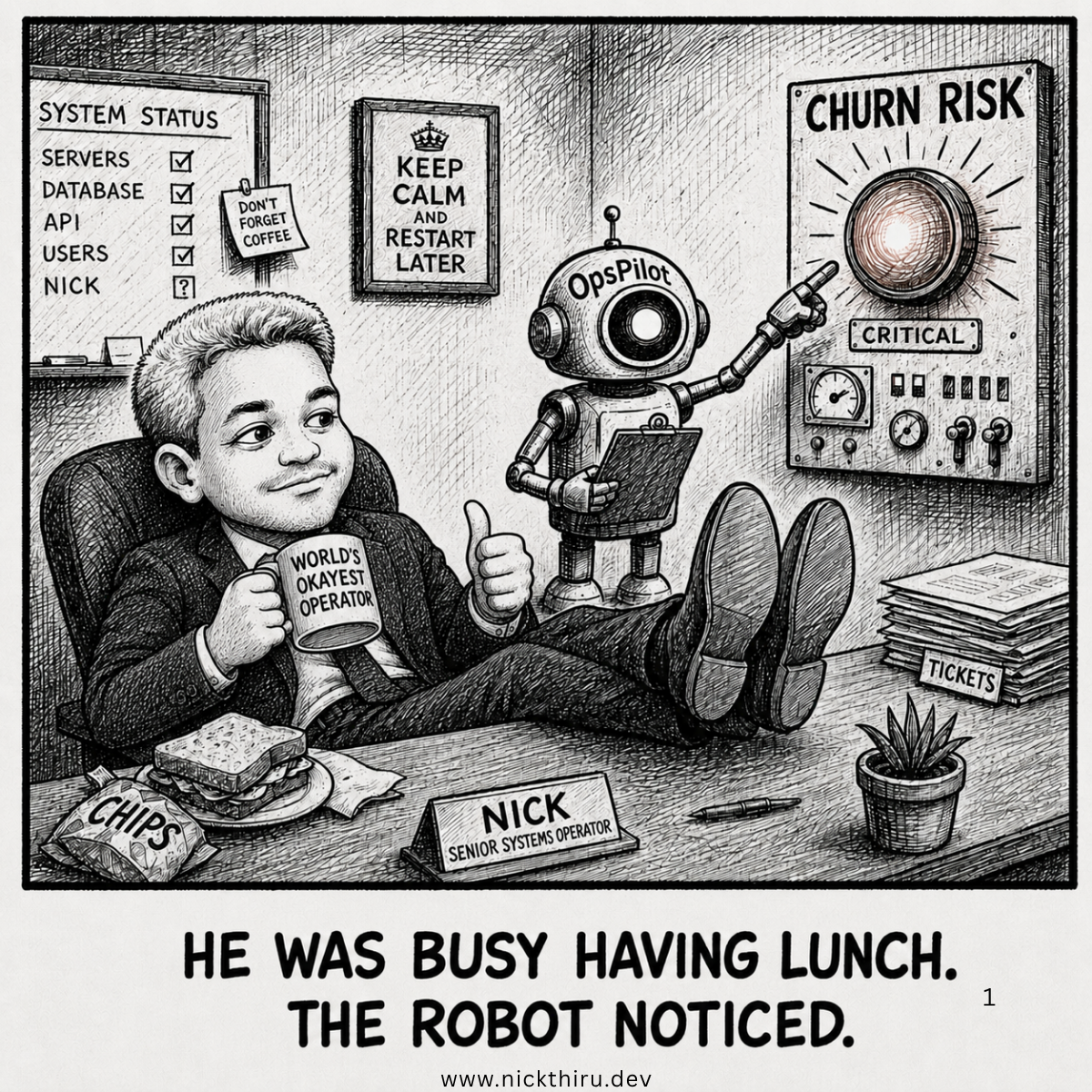
The User Moment
OpsPilot started as an idea I could describe in a sentence: a tool to help operators, solo founders, but also the small teams that grow out from them, stay on top of their business as it gets more complex than one person can track. I sat down to turn that idea into a real product vision, expecting to mostly formalize what I already had in my head. Instead, one question undid the whole thing: who is this actually for, and what do they need that they don’t already have?
The honest answer wasn’t flattering. The idea I’d been carrying around was built to make me feel informed: one person’s workflow, not a business that might have two or three people wearing operational hats instead of just one. That gap is the real subject of this post.
The Design Problem
Picture an operator running a SaaS product or a digitally-native small business doing somewhere between \$10K and \$500K in annual revenue. It might be one founder. It might be a tiny team of two or three, split across product, customer support, and finance. Either way, they’re not a hobbyist. They have paying customers, real cash flow risk, and real churn to manage.
What they don’t have is a dedicated finance department, a dedicated sales & marketing function, a support team, or an ops lead. So one or two people end up filling all four roles at once: closing the books, running outreach and retention, answering the support queue, and being the only person who notices when something’s about to go wrong across all of it. The tools they use are competent at each individual job. What none of them do is talk to each other.
Here’s what actually happens: someone opens QuickBooks to check cash position, switches to Stripe to see if a customer’s card failed, switches to Intercom to see if that same customer has an open complaint. By the time the pieces come together into “this customer is a churn risk,” the moment to act has often already passed. It’s not just risk that gets missed this way. The same fragmentation hides the upside too: a customer approaching a usage threshold, a customer whose ticket volume just dropped because they finally figured the product out, the exact signals that make for a well-timed upsell are invisible unless someone manually correlates three tools at once, which nobody has time to do at scale.
That’s the actual problem: not a lack of tools, but a lack of relationships between tools. A team wearing four functions between one and three people doesn’t need six more single-purpose apps. They need the picture that emerges only when finance, marketing, support, and usage data sit next to each other: a picture that gets more valuable, not less, as the team grows from one person to a handful.
The Options
The obvious answer is “build a better dashboard.” I considered it seriously, because it’s the cheapest option and it’s what most tools in this space do: pull data from a few sources into one screen so you’re not tab-switching.
But a dashboard is still read-only. It shows you the fire; it doesn’t put it out, and it doesn’t tell you it’s starting before it’s visible. An operator staring at five charts instead of five tabs has saved a little time and gained nothing in judgment. The cognitive load didn’t disappear, it just got prettier.
The other tempting option was to build native replacements: our own billing, our own support desk, our own monitoring, and pull everyone into one ecosystem. That solves the data-fragmentation problem cleanly, but it creates a much bigger one: it asks an operator who is already stretched thin to migrate off tools they’ve configured, trust, and depend on, during the exact period when they can least afford disruption. Migration is where products like this go to die.
What I actually needed was something that treated the operator’s existing tools as fixed points, not obstacles, with the option, later, to offer tighter native alternatives to anyone who wants them, not as a requirement to get started.
The Build
What I landed on has three parts, and each one exists to solve a specific piece of the problem above.
The first is an integration marketplace: pre-built connectors into the tools an operator is already running: accounting, billing, support, monitoring, CRM. The point isn’t the connector count. It’s that adoption requires zero migration. You keep QuickBooks, you keep Stripe, you keep Intercom; OpsPilot plugs into what you already trust instead of asking you to replace it.
The second is a unified operational data layer underneath those connectors, a place where a support ticket, a failed payment, and a usage drop-off aren’t three disconnected facts in three different apps, but three data points about the same customer, related to each other automatically. This is the part that actually closes the gap I found in my own workflow: the twenty minutes I used to spend correlating information by hand becomes something the system has already done before I open the app.
The third is an agentic reasoning layer that sits on top of that unified data and does something a dashboard structurally cannot: it acts. It can flag that a customer showing a failed payment, a rising ticket count, and shrinking usage is a churn risk before they cancel, and it can draft the outreach, triage the incident, or surface the decision for a human to approve. The same reasoning works in the other direction too: spotting a customer whose usage is climbing and whose support load just dropped, and surfacing that as an expansion opportunity instead of letting it sit unnoticed in someone’s billing history. The system runs on a spectrum from full automation to AI-assisted human review, so the operator decides how much of the judgment they hand over and where they stay in the loop.
What separates this from a smarter dashboard is that category difference: a dashboard tells you where to look; this tells you what’s happening and gives you a lever to pull. And underneath all of it sits a tenant-scoped data sovereignty architecture: every business’s data is isolated at the storage, embedding, retrieval, and reasoning layer from every other business on the OpsPilot platform, whether you’re a single founder or a small-to-medium-sized team sharing the same view internally.
The Verdict
I don’t think this is a dashboard problem, and I’ve stopped building it like one. The version of OpsPilot that came out of this exercise isn’t a better window into scattered tools. It’s an attempt to make those tools behave like one system, without asking anyone to give up what they’re already using.
Here’s the tradeoff I’m sitting with honestly: the entire value proposition now depends on other people’s APIs staying open and stable. If a tool an operator relies on restricts third-party access or changes its terms, the unified picture underneath it gets a hole in it. That’s not a risk I can engineer away — it’s a bet that an integration-first approach is worth more to operators than the fragility it introduces, and it’s one I’ll be watching closely as this gets built.
Your Turn
If you’re running your business, alone or with a small team, across half a dozen disconnected tools right now, which two of them, if they could actually see each other’s data, would save you the most time this week?
Have thoughts on this? I'd love to hear them. The conversation is happening on:
Now Building
OpsPilot
SMBs will be able to run their entire business with the operational efficiency and intelligence previously available only to enterprises with dedicated accounting, finance, customer support, sales & marketing, and operations teams.
Learn more and join the waitlist