1 Fast, Cheap, or Accurate…Why Not All Three!
PolicyForge — Fast, Cheap, or Accurate…Why Not All Three!
· 7 min read
Product PolicyForge Strategy
You're reading Part 1 of 16 in the PolicyForge series.
Use the Series Navigation button at the top-right to browse all posts in the series.
The User Moment
Imagine you’re the VP of Operations at a 30-person healthcare startup. You’ve never had to think much about “written information security policy”, until an insurance renewal notice lands with a hard deadline, and it says: no documented policies, no renewal, no coverage. Or maybe it’s an audit notice instead, with 60 to 90 days to produce evidence that your company has real, specific controls in place.
You’re not a compliance expert. You don’t have a security team. What you have is a tech stack you understand well, a deadline you can’t move, and two bad options in front of you: pay a consultant $5,000–$15,000 and wait two to three weeks you may not have, or download a generic policy template that any auditor will spot as boilerplate in about thirty seconds.
The Design Problem
The hard part isn’t writing a security policy. Templates for that exist everywhere, for free. The hard part is writing one that’s actually true — one that reflects your real technology stack, your real data handling, your real vendor relationships — and doing it fast enough to matter, without a compliance background to draw on.
That combination is what most solutions fail to solve. Consultants solve for accuracy but not speed or cost. Templates solve for speed and cost but not accuracy. Nobody was targeting the specific person stuck in the middle: technically capable, time-constrained, and unsupported.
Underneath that, there are really three separate needs pulling at once. Speed comes first: if policies can’t be produced in days rather than weeks, nothing else matters, because the deadline is the thing that fails first. Specificity comes second: a generic document gets flagged the moment an auditor or insurer compares it against the company’s actual environment, so the policy has to reflect the real tech stack and real data handling, not a placeholder version of it. And completeness comes third, in a quieter but just as costly way: someone without a compliance background has no independent way to check whether they’ve covered everything a framework requires, so they need visibility into whether the required controls are actually represented before they submit anything. Solve for one of these alone and you’ve built a template site or a consulting shortcut. Solve for all three together, and you’ve built something that didn’t really exist for this person before.
The Options
A few different shapes for this product were on the table.
One option: build a template library and let people fill in the blanks themselves. Fast to build, but it inherits the same weakness as every static template: it doesn’t know anything about the actual organization using it, and auditors know the difference.
Another option: build something closer to a lightweight consulting marketplace, connecting companies to affordable freelance compliance help. This solves the trust problem but not the speed problem, as you’re still waiting on a human’s calendar.
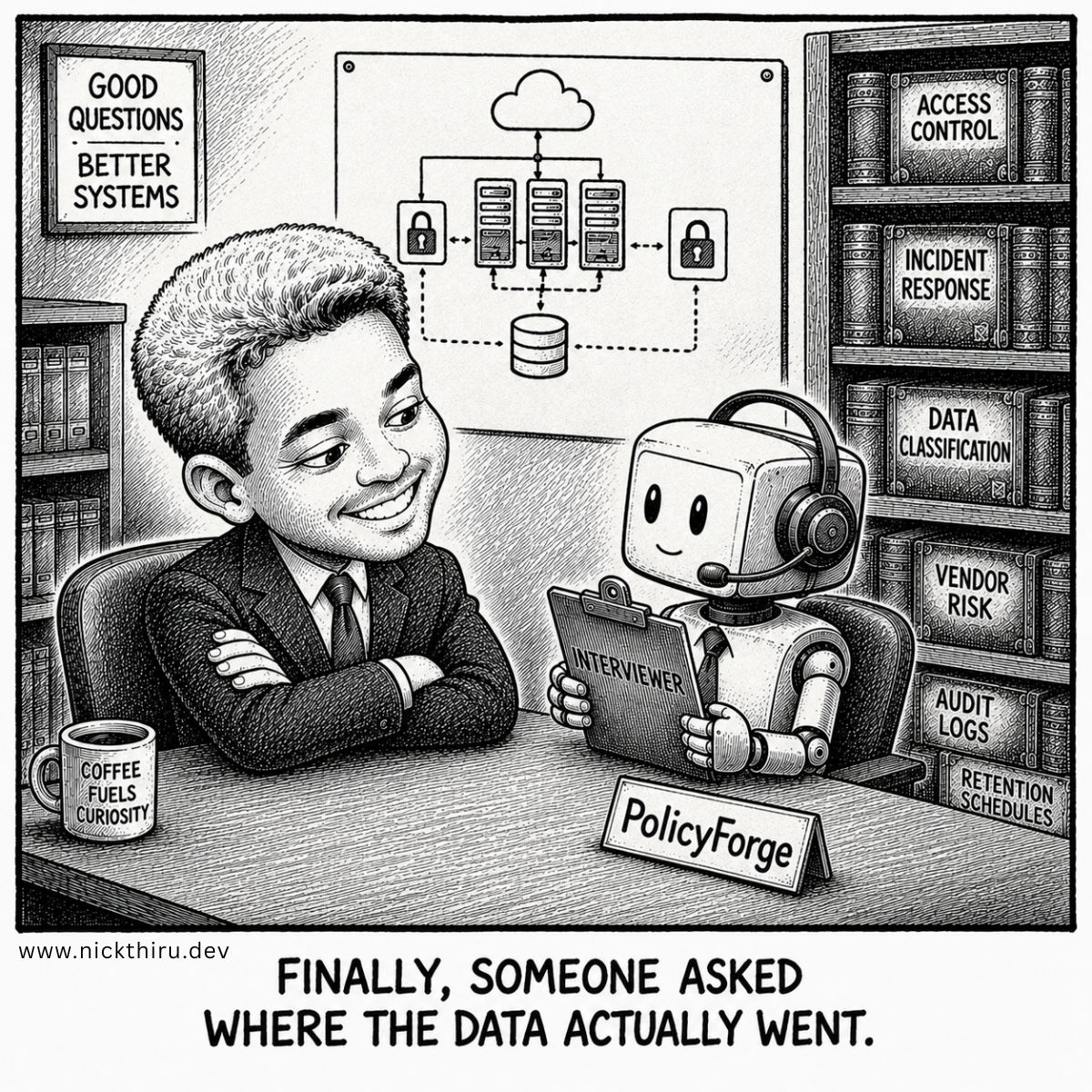
The option that won: a guided interview that asks the questions a compliance consultant would ask about your tech stack, your data flows, your existing controls, and a mapping engine that translates those specific answers directly into policy language aligned to the framework you need (SOC 2, ISO 27001, HIPAA). No templates to fill in. No consultant’s calendar to wait on.
Put next to the two paths not taken, the gap becomes clearer. A traditional compliance consultant typically means several weeks of discovery calls and custom writing, at a cost that can run from a few thousand dollars into the tens of thousands, plus the internal disruption of pulling people into meetings to answer the same questions a consultant would eventually ask anyway. Generic templates avoid that cost and delay, but they’re static by nature because they don’t adapt to a specific environment, they go stale as frameworks and controls change, and they force the user to reverse-engineer what a compliance-literate version of “their” policy would even look like. The guided-interview approach was chosen because it’s the only one of the three that doesn’t force a trade between those two failure modes: it keeps the speed and cost of a template while keeping the specificity that only a human consultant used to be able to provide.
The Build
What shipped is a short, structured interview that takes around fifteen minutes to complete, followed by a document generation step that takes a couple of minutes. The output is a set of policies specific to your organization: your systems, your access controls, your vendors, mapped to the framework your auditor or insurer actually cares about.
The pricing reflects the philosophy directly: instead of thousands of dollars and weeks of back-and-forth, this is priced closer to what a template costs, but produces something a template never could. That is, a document that’s actually about your company.
Underneath that interview and generation step, a few distinct pieces do the actual work. An onboarding interview agent runs the conversation itself, capturing the organization’s industry, structure, technology stack, data types, existing security maturity, and which framework it needs to comply with. Those answers feed a mapping engine, whose job is specifically to check that nothing required by the chosen framework has been left uncovered, rather than just generating whatever the interview happened to surface. From there, document generation produces the actual policy set — things like incident response, access control, and data classification policies, each written around the organization’s specific answers rather than filled in from a template. Because compliance isn’t a one-time event, there’s also a versioning layer that stores each generated set and prompts a re-check roughly every six months, with the option to re-run the interview and see what’s changed rather than starting over. And once policies are ready, they can be exported as PDF, Word, or HTML, in whatever form an auditor, insurer, or customer actually needs to receive them.
What surprised us most in shaping this vision wasn’t the product mechanics, it was how much of the value lives in trust. A policy that’s fast and cheap but wrong is worse than useless; it creates false confidence right before an audit. So a meaningful part of the vision isn’t just “generate the policy”, it’s building in enough specificity and traceability that the output can actually survive an auditor’s questions. Part of that traceability, longer-term, is meant to work in both directions: not just generating a policy from the interview answers, but being able to show which specific control or requirement each generated policy is meant to satisfy, so coverage can be checked rather than taken on faith. That piece is explicitly a nice-to-have for the first version rather than something promised out of the gate, but it’s the direction the traceability work is meant to grow into.
The Verdict
Does this solve the actual problem? On paper, yes, it directly targets the two things that make the status quo painful: time and cost, without sacrificing the specificity that makes a policy usable. The honest caveat is that this is a vision, not a finished, battle-tested product yet. The real test is whether policies generated this way hold up when a real auditor looks at them, and whether people going through something as consequential as a compliance deadline are willing to trust an automated process with it. Those are exactly the questions being validated next, before this goes in front of a wider audience.
Concretely, that validation has a few specific bars to clear before this goes in front of a wider audience: a small group of early users actually completing the interview at a healthy rate, the generated policies being submitted to real auditors and coming back with minimal rework requested rather than major revisions, and organizations confirming the policies actually match how they run day to day rather than just sounding plausible on paper. None of that is guaranteed yet, which is exactly why it’s framed as a vision being tested rather than a finished claim.
Your Turn
If you’ve ever been the person staring down a compliance deadline with no compliance team to lean on, what did you end up doing, and what would have actually made that moment easier?
Have thoughts on this? I'd love to hear them. The conversation is happening on:
Now Building
PolicyForge
Generate compliant cybersecurity policies in minutes instead of weeks. Answer 15–20 questions about your technology stack and controls. Get framework-aligned security policies ready for audit submission. No expensive consulting.
Learn more and join the waitlist